

WORDS Sara Belkadi
HEADER IMAGE Still from ‘The Eternal Daughter’ Courtesty of A24
Fresh off the UK cinema release of ‘The Eternal Daughter’, Tilda Swinton touched down in Morocco for the 20th anniversary edition of the Marrakech International Film Festival, held from November 24 – December 2.
A patron since 2019, receiving an honorary award for her life’s work at the last festival, the Scottish actress led her first masterclass appearance at the Palais de Congres on the 27th – the third actor in the “in conversation with” program this year, following on from Mads Mikkelson and Willem Dafoe.
During her masterclass, moderated by Andreéa Picard, a programmer at TIFF, when asked why she continues to return she happily exclaimed, “The films are extraordinary! I mean literally extraordinary. There’s nowhere else so far to find this kind of portal into filmmaking from a section of the globe that doesn’t often get this kind of attention. But mainly I’d say I love the audience! There’s something about their youth and cineliteracy, there’s a purity. I’ll come and come and come again!”
She recounted her 53-year-long relationship with collaborator and school friend Joanna Hogg, the director of ‘The Eternal Daughter’, stating they were having “filmmakers conversations at age 10”.

While talking about her youth, she spoke about her first experience of arts programming – a real love of hers – organising screenings in a defunct bingo hall in her small Scottish town. She uses the time to make it clear that she doesn’t consider herself to be an actress. Despite her impressive filmography of over 50 films, when she explained why she’s a “performer” not an actress, the distinction makes sense.
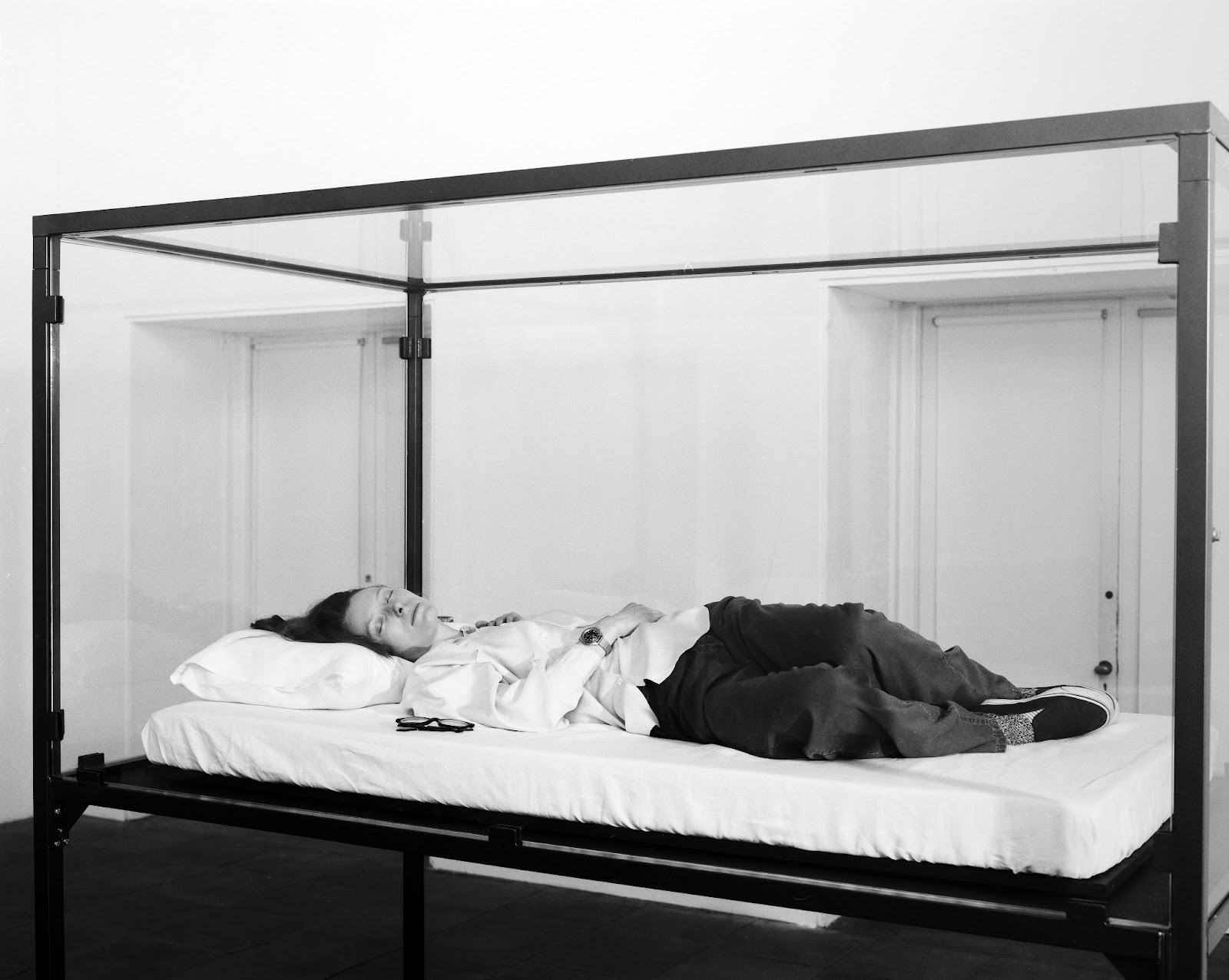
Steering away from acting (or rather ‘performing’), she spoke of “The Maybe” – a continuous piece where she turns up sleeping in a glass vitrine in a museum somewhere around the world. First doing so in 1995 at the Serpentine Gallery in London and last in 2013 at the MOMA, New York, the performance is an elusive piece, considering the fact she never announces when she will be doing it or put out any statement regarding its meaning.
Having her explain to me how she evolved the piece and what it means was an exceptional honour and cleared many of the question marks I’ve had as a long-time admirer. She confirmed, “I am intending to do it again, when least expected”.
To clear up some of your question marks, I’ll let her speak for herself.
Earlier in your masterclass, you said you despise the term “actor” [I see her face slightly questioning that], or perhaps despise was too strong of a word?
I don’t despise the term “actor”. I know that many people claim it justly as something really worthwhile for them. It’s just inaccurate for me.
What would you label yourself as, if you believe in one?
I think it’s fair, I’ve worked for over 30 years as a film performer. So of course I can’t deny it, but I would maybe call myself a performer. That for me speaks to something which acknowledges my autobiographical work that’s not interpretative and that’s actually maybe improvised and draws on the writer in me. So I don’t feel invested in acting as such. I never trained as an actor. I was never interested in being an actor. So I always feel I should be the first to say that I’m not an actor before somebody else does.
To go away from your film work then, you touched on “The Maybe” in your panel. How does observation play a role in the piece, particularly as a ‘performer’ and what does it mean to you?
The thing about “The Maybe”, when I first made it, it was a response to something very profound in my life, which was not only the death of Derek Jarman, but also many many of my friends from AIDS. I was 33 in 1994 when I went to 43 funerals of my friends. This was a big, big, big moment for us. I think one of the first, sort of impulses, that grew the “The Maybe” was, I was so over, sitting beside my dying friends and I started to imagine what it would be to give a living, healthy, sleeping body to a public space. The thing about it being in a glass case is, you can choose your distance. You can come very, very close and you can see me, all the hairs up my nose and you can see my ears. Or you can stand at the back of the room and you can see it like you are seeing me now, like a cinema screen or farther. That for me was a very cinematic gesture. It’s one of the things I love about the cinema, you can choose your level and distance, and the camera can come in very close and also range very far and wide
So, it was a turning point for me because Derek had died, his way of working I’d described had gone and I didn’t know what I was going to do. I wanted to make an experiment that was half about live performance, which I love. I really value live performance although I’m just not in love with the theatre because I feel like I wouldn’t want to come closer than you are now. That feeling of sort of rigour of the space is always something a little limiting for me.
I think “The Maybe” really sums up a bit of a quest for me for something that is really non-performed but alive and that you can scrutinise. You know the way on screen, you can look at an unwashed face, particularly of a non-performer. This is one of the reasons I love documentaries. You see someone who’s never seen themselves on screen, so they’re not pushing anything at us.
I found it fascinating at your panel when you said that for you, “commercial” work is experimental. Which of your “commercial” roles do you think you’ve given the most breadth to be your authentic self as a performer?
I have to do a quick flip in my mind. There is always something really interesting about being put into some kind of box so that you can fill it and maybe try and affect the edges of it. Working with the template of the ‘White Witch’ in the Narnia films was really interesting because there was this idea of the ‘White Witch’, who’s the epitome of all evil being incredibly cold. But that means somehow, there was an implication that she would be very loud and domineering. So I wanted to work with something softer and quieter and for me, more threatening. That was one sort of adventure I had, of course also working with Marvel. Working with again, this impersonation of ‘The Ancient One’ and the feeling that ‘The Ancient One’ could be someone incredibly relaxed rather than somebody, again very domineering or very overbearing. That was also, sort of, trying to tweak the stereotype a little.
Few actors get to have the experience you do, dabbling in artistic indie films and “commercial” work. How have you managed to strike that balance?
I always choose the people, you know? It takes two to tango and you need to be in collaboration. I don’t know how it would be possible for me to go into an already set-up scenario and hold my own without a collaboration. That’s the thing that drives things for me is always finding the conversation and finding the collaboration.
Amongst the many things people have called you over the years, one that sticks out is ‘fashion icon’, tell me about your relationship to fashion.
Well, my relationship with fashion, which I wouldn’t say is fully accurate, I don’t really have a relationship with fashion as such. I have a relationship with certain designers who I happen to know and love. They make looks for me, sometimes literally designed for me, or they adapt things that they’ve shown in collections and it’s again a very personal thing. So my relationship with fashion, as you describe it, is actually my relationship with these people.

Particularly Chanel, right?
Chanel I’ve worked with for a decade. I work with them now very closely as an ambassador for their arts and culture programme. That’s something that means a lot to me because they’ve got a wide reach, as you might imagine, and they take their responsibility as art patron really seriously. They’re giving away a lot of that money to artists, to develop artists’ practice and to uphold the sanctity of artists’ lives.
There are two big prizes that I’m very closely involved in. We’re in the second year of both. One is with the BFI for filmmakers, not for a particular film, but for the voices of emerging filmmakers. And then there’s a big prize called the Next Prize which is for artists of all disciplines. It’s enormous! It’s like €1,000,000 that they give as a kind of ‘genius grant’ divided between 10 artists a year. I’m very proud to work with them on these initiatives.
You said earlier that arts programming is where your heart’s lying right now. Anything we can keep our eyes on?
It’s always been where my heart lies. No particular plans at the moment, I’m always longing to take over a big multiplex somewhere and do a kind of flash mob screening over a weekend when people are expecting they’re only able to see a new blockbuster and show them some Ozu.
Perhaps a return to the bingo halls of Scotland?
Ah well, that’s always bubbling along in the background! I would really, really love to do that again. Never say never.
Enjoyed this story? Help keep independent queer-led publishing alive and unlock the BRICKS Learner Platform, full of resources for emerging and aspiring creatives sent to you every week via newsletter. Start your 30-day free trial now.